Last Updated: December 18, 2023
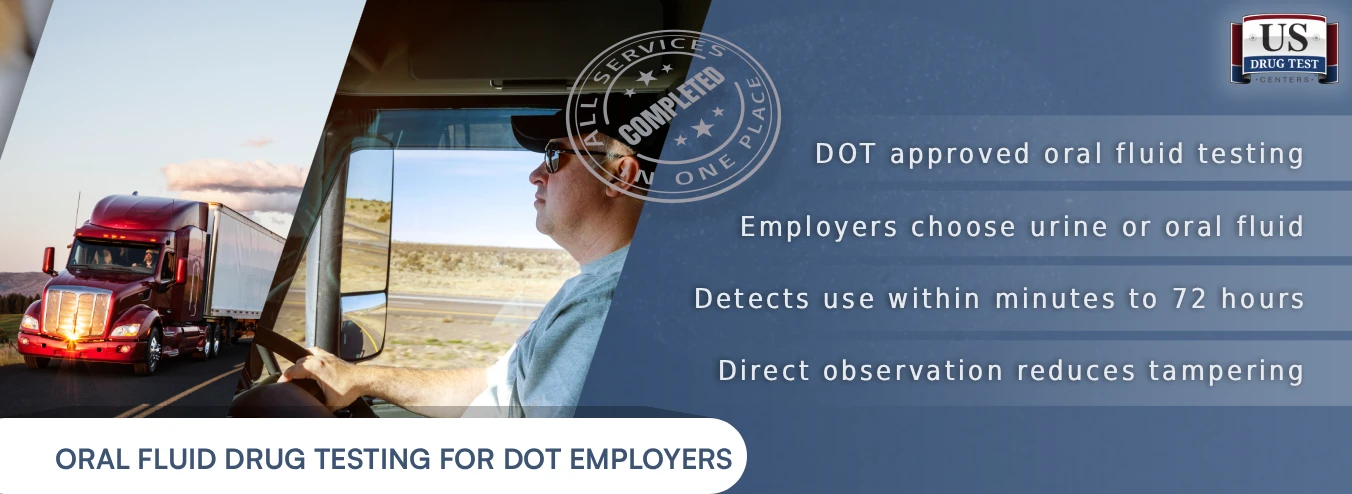
The United States Department of Transportation (DOT) has approved oral fluid drug testing for DOT-regulated employers. Oral fluid testing will not begin until two laboratories are certified by the United States Department of Health and Human Services (HHS). This is not expected until late 2023 or early 2024.
The new oral fluid testing rules will affect all DOT agency drug and alcohol testing programs, including:
The United States Coast Guard (USCG) will also adopt the new DOT rules for oral fluid drug testing.
Oral fluid testing has existed for many years for non-DOT drug testing programs. It is an accurate method of testing for drugs and, in fact, typically picks up more positive results. The main difference between urine and oral testing is the detection time. For urine testing, it’s usually six to eight hours after drug use, and for oral fluid testing, it’s almost immediate, especially for marijuana.

Ready to learn more? We're standing by to assist you! For assistance, call 866-566-0261 or order your test online!
Urine drug testing is not going away in the DOT drug testing program. Oral fluid is an alternative specimen that can be used as authorized by the employer. Only the employer can authorize the use of either urine or oral fluid or switch to the other when there might be a problem collection such as:
Applicants and employees cannot choose for themselves between urine and oral fluid testing. Collectors cannot make the decision to perform urine or oral fluid testing. The choice as the regulation stipulates is always an employer decision.
There is one situation where oral fluid will be required. Oral fluid testing must be available for directly observed collections for transgender and nonbinary individuals.
Employers are encouraged to have standing orders so that the collectors know what specimen they need to collect for regular collections and for direct observation, shy bladder, and dry mouth collections. The standing orders should include information on when to switch from urine to oral fluid or oral fluid to urine.
US Drug Test Centers is an industry leader in DOT drug testing, and this will now include oral fluid drug testing. Our new and existing clients will have full services available with urine drug testing, oral fluid drug testing, and/or a combination of urine and oral.
US Drug Test Centers will assist new and existing clients with setting up accounts for oral fluid testing. Assistance will be provided for employers to develop standing orders from the employer so that collectors know what specimen they need to collect for regular collections and for dry mouth, direct observation, and shy bladder situations. This will provide maximum efficiency for DOT drug and alcohol testing programs.
Contact Us for more information on oral fluid testing.

The new rule applies to safety-sensitive employees in the transportation industry. This includes all agencies covered by DOT regulations, including the Federal Aviation Administration (FAA), the Federal Motor Carrier Safety Administration (FMCSA), the Federal Railroad Administration (FRA) and the Federal Transit Administration (FTA). The rule will also affect specimen collectors, laboratories and medical review officer’s. This is a Federal program so no State drug testing laws will affect this program.
This final rule is effective on June 1, 2023. However, oral fluid collections will not be available for DOT-regulated employers until such a time as the Department of Health and Human Services (DHHS) approves two laboratories for oral fluid. Also, an oral fluid specimen collection device must become available and be FDA approved. It is estimated that none of this will happen until first quarter or 2024 or later.
Oral fluid testing was implemented as an alternative to urine drug testing providing options for employers to use oral fluid and/or urine specimens. Additionally, DOT was required to harmonize with pertinent sections of the HHS/SAMHSA oral fluid Mandatory Guidelines. Some specific reasons to add oral fluid are:
Collection sites, applicants and employees cannot choose which specimen to be used. Only the employer can authorize the use of either urine or oral fluid or switch to the other when there might be a problem collection such as:
As with urine, detection times vary and is not an exact science. Oral fluid drug testing will for sure have more recent use detection. A drug may be detected in oral fluid in less than one hour and remain detectable for five up to 48 hours after last use.
DOT oral fluid drug testing can be used for any of the DOT reasons for testing which include:
Collectors will need to be trained to perform oral fluid collections and the training will include methods to observe potential cheating. Potential cheating techniques might be drinking excessive amounts of water, using products that claim to clean oral fluid, aggressively brushing their teeth, tongue, and cheeks, excessively rinsing with antiseptic mouthwash, chewing ice and or eating mints. DOT regulation 49 CFR Part 40 states:
Additional steps for the oral fluid collection including a potential 10 minute period are outlined in DOT Rule 49 CFR Part 40 Section 40.72.
There is really no affect on Clearinghouse. All Clearinghouse requirements will remain to include reporting of violations including positive tests, refusals and actual knowledge. There would not be a Clearinghouse separate section to report violations.
There are a few things you can do now to start to prepare for oral fluid drug testing.
You would not have to have an option for urine, but you might lose business from employers who prefer to use urine specimens in certain situations. In addition, in a dry mouth situation, upon employer request you would not be able to switch over to a urine collection.
As employers make decisions on whether to use urine, oral fluid or a combination of both; the employer should communicate these decisions to the collection facilities they are utilizing. These decisions formulate what will be called “Standing Orders” to provide to the collection sites and C/TPA’s. If the employer has a standing order to allow oral fluid testing in such situations, the collector will follow that order. If the collection site is not aware of the standing order, they should be contacting the employee's Designated Employer Representative (DER) to determine which specimen to use. An example of a “Standing Order” could be:
Use oral fluid specimen collection:









Corporate Account
Share the basics and then we will route you to the right setup page.


 Download

