




US Drug Test Centers Blog
FAA Drug Testing Audits: What Employers Need to Know and Common Reasons Companies Fail
For employers regulated by the Federal Aviation Administration (FAA), maintaining a compliant drug and alcohol testing program is more than just a regulatory requirement, it's an essential part of aviation safety.
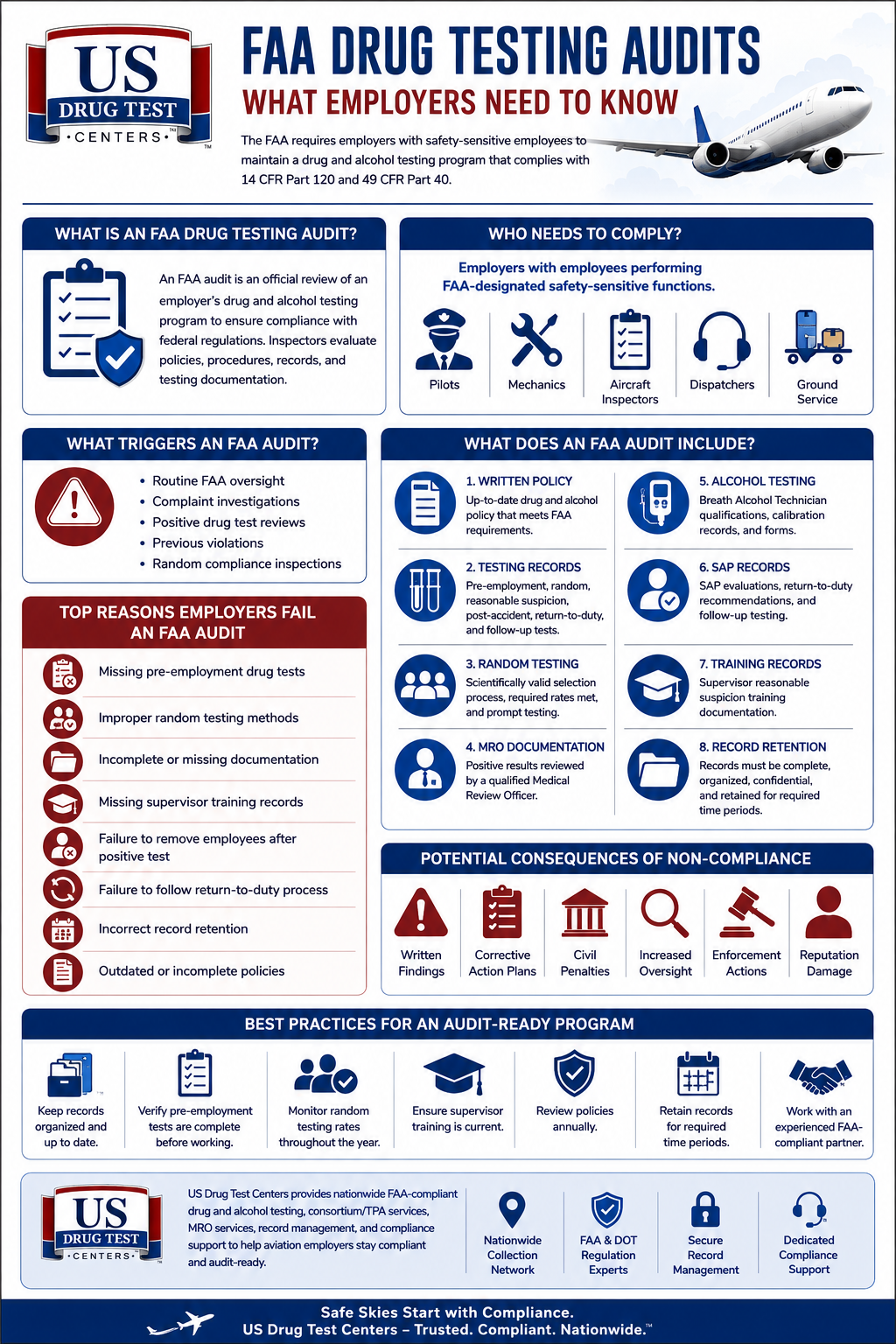
The FAA requires employers performing safety-sensitive aviation functions to implement and maintain a drug and alcohol testing program that complies with 14 CFR Part 120 and 49 CFR Part 40. During an FAA inspection or audit, regulators review these programs to ensure employers are following every requirement.
Unfortunately, many employers unknowingly make compliance mistakes that can lead to violations, civil penalties, corrective action plans, or increased regulatory scrutiny.
This guide explains what an FAA drug testing audit is, who gets audited, what inspectors review, and the most common reasons employers fail an FAA audit.
What Is an FAA Drug Testing Audit?
An FAA drug and alcohol testing audit is an official review of an employer's compliance with federal drug and alcohol testing regulations. The FAA conducts audits based on routine oversight, inspections, complaints, previous compliance history, and other risk factors. There is no fixed audit schedule that applies to every employer.
Unlike a DOT roadside inspection, an FAA audit focuses almost entirely on documentation, policies, testing procedures, and program management. The purpose is to verify that aviation employers have established and maintained a compliant drug and alcohol testing program for employees performing safety-sensitive duties.
FAA inspectors evaluate whether the company has adequate systems in place to ensure ongoing compliance, not just whether individual drug tests were performed.
Who Must Comply with FAA Drug Testing Regulations?
FAA drug and alcohol testing regulations apply to employers with employees performing FAA-designated safety-sensitive functions.
These may include:
- Airlines
- Air charter operators
- Aircraft maintenance facilities
- Repair stations
- Aircraft manufacturers
- Air traffic organizations
- Ground service providers
- Cargo operators
- Aviation contractors
Employees performing safety-sensitive duties may include:
- Pilots
- Mechanics
- Aircraft inspectors
- Dispatchers
- Flight crew members
- Ground security coordinators
- Aircraft maintenance personnel
- Anyone performing FAA-designated safety-sensitive functions
What Regulations Govern FAA Drug Testing?
FAA testing programs primarily follow:
- 14 CFR Part 120
- 49 CFR Part 40
While Part 40 establishes procedures for all DOT agencies, Part 120 contains FAA-specific requirements.
These regulations cover:
- Drug testing
- Alcohol testing
- Collection procedures
- Medical Review Officer (MRO) responsibilities
- Substance Abuse Professional (SAP) requirements
- Record retention
- Employee education
- Supervisor training
- Return-to-duty testing
- Follow-up testing
What Triggers an FAA Audit?
An FAA inspection can occur for several reasons.
Routine Oversight
Many audits are simply part of normal FAA oversight.
Complaint Investigations
The FAA may investigate reports of non-compliance.
Positive Drug Test Reviews
Repeated positive tests or program deficiencies may receive additional attention.
Previous Violations
Companies with previous compliance issues are often monitored more closely.
Random Compliance Inspections
Some employers are selected as part of ongoing FAA oversight programs.
What Does an FAA Drug Testing Audit Include?
FAA inspectors typically review nearly every aspect of an employer's drug and alcohol testing program.
Written Drug and Alcohol Policy
Inspectors verify that employers maintain an up-to-date written policy that complies with FAA regulations.
The policy should clearly address:
- Prohibited conduct
- Testing procedures
- Employee responsibilities
- Consequences of violations
- Return-to-duty process
- Employee assistance information
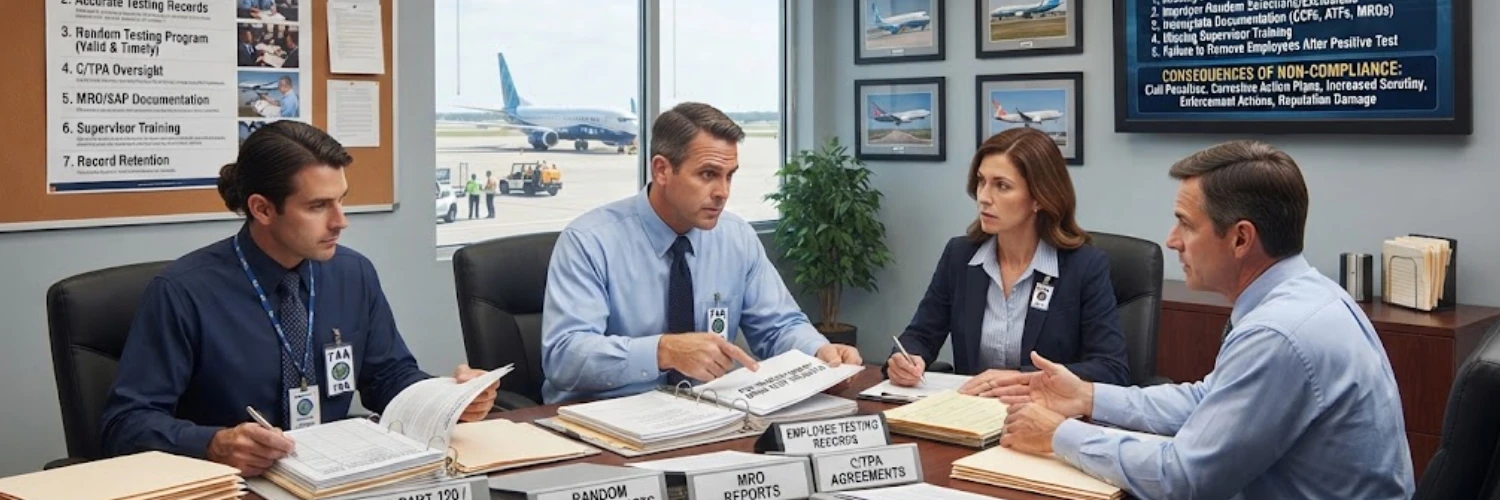
Employee Testing Records
Auditors review documentation for:
- Pre-employment drug tests
- Random drug testing
- Reasonable suspicion testing
- Post-accident testing
- Return-to-duty testing
- Follow-up testing
Missing documentation is one of the most common audit findings.
Random Testing Program
Random testing is one of the most heavily scrutinized areas.
Inspectors verify:
- Employees were selected using a scientifically valid random method
- Required annual testing rates were met
- Random selections occurred throughout the year
- Employees were tested promptly after selection
- No employee was intentionally excluded
Consortium or Third-Party Administrator (C/TPA)
If an employer uses a consortium or third-party administrator, inspectors review:
- Service agreements
- Testing records
- Random selection documentation
- Collection site procedures
- Reporting accuracy
Even when using a C/TPA, the employer remains responsible for compliance.
Medical Review Officer (MRO) Documentation
FAA auditors verify:
- Positive laboratory results were reviewed by a qualified Medical Review Officer
- Verified results were properly documented
- Confidentiality requirements were followed
Alcohol Testing Records
Inspectors examine:
- Breath Alcohol Technician qualifications
- Device calibration records
- Alcohol testing forms
- Confirmation tests
- Testing documentation
Substance Abuse Professional (SAP) Records
When applicable, inspectors review:
- SAP evaluations
- Return-to-duty recommendations
- Follow-up testing schedules
- Completion documentation
Training Records
FAA regulations require training for supervisors who make reasonable suspicion determinations. Inspectors verify documentation showing supervisors completed required training.
Employee Education
Employers must provide educational materials regarding:
- Drug misuse
- Alcohol misuse
- Company policy
- Employee responsibilities
Record Retention
FAA regulations require maintaining records for specified periods depending on the document type.
Inspectors verify:
- Records are complete.
- Records are organized.
- Confidential files are protected.
- Retention requirements are met.
Common Reasons Employers Fail FAA Audits
Most FAA audit findings are preventable with good compliance practices.
Here are the most common issues:
Missing Pre-Employment Drug Tests
Every safety-sensitive employee must receive a negative pre-employment drug test before performing covered duties. Missing documentation is a frequent violation.
Improper Random Testing
Random testing problems often include:
- Employees not selected randomly
- Incorrect testing percentages
- Delayed testing after selection
- Predictable selection patterns
- Employees repeatedly excluded
Incomplete Documentation
Even when testing occurred, employers sometimes cannot produce:
- Custody and Control Forms (CCFs)
- Alcohol Testing Forms (ATFs)
- Laboratory reports
- MRO verification reports
- Random selection reports
If documentation is missing, auditors may treat the test as though it never occurred.
Poor Record Organization
Many employers have all required records but cannot locate them quickly during an audit. Disorganized documentation often creates unnecessary compliance concerns.
Missing Supervisor Training
FAA regulations require supervisors making reasonable suspicion determinations to receive specific training. Missing certificates or attendance records are common findings.
Failure to Remove Employees After Positive Tests
Employees who receive verified positive drug test results must be immediately removed from safety-sensitive duties. Allowing an employee to continue performing covered functions can result in serious violations.
Failure to Follow Return-to-Duty Procedures
After a positive test, employers must follow the complete return-to-duty process. Skipping required SAP evaluations, return-to-duty testing, or follow-up testing is a major compliance issue.
Incorrect Record Retention
Destroying records too early or failing to retain required documentation can result in audit findings.
Outdated Policies
Some employers continue using policies based on older regulations. Policies should be reviewed regularly to ensure they reflect current FAA and DOT requirements.
Potential Consequences of an FAA Audit Failure
Non-compliance can result in:
- Written findings
- Corrective Action Plans
- Additional inspections
- Civil penalties
- Increased regulatory oversight
- Enforcement actions
- Damage to company reputation
While audits can seem intimidating, most violations are preventable through consistent recordkeeping, proper training, and adherence to FAA and DOT regulations.
Best Practices for Passing an FAA Audit
Successful employers prepare for audits every day, not just when notified of an inspection.
Recommended best practices include:
- Maintain organized electronic and paper records
- Conduct annual internal compliance reviews
- Verify all pre-employment tests are complete before employees begin safety-sensitive work
- Monitor random testing percentages throughout the year
- Ensure supervisor training remains current
- Review written policies annually
- Retain documentation according to FAA requirements
- Work with experienced FAA-compliant testing providers
Although a consortium or third-party administrator may assist with program management, the employer remains ultimately responsible for compliance with FAA regulations.
How US Drug Test Centers Helps FAA-Regulated Employers
US Drug Test Centers provides comprehensive FAA-compliant drug and alcohol testing solutions for aviation employers across the United States. Whether you're an airline, repair station, charter operator, maintenance facility, or aviation contractor, our team helps simplify compliance while supporting your safety program.
Our services include:
- FAA drug & alcohol testing
- Nationwide collection sites
- Random testing program administration
- Consortium/Third-Party Administrator (C/TPA) services
- Medical Review Officer (MRO) services
- Electronic record management
- DOT and FAA compliance assistance
- Supervisor training resources
- Return-to-duty and follow-up testing coordination
The best strategy is to maintain an audit-ready program every day rather than trying to prepare only after receiving an audit notice. By partnering with an experienced compliance provider like US Drug Test Centers, aviation employers can simplify their drug and alcohol testing programs, improve documentation, and reduce the risk of costly audit findings.