




US Drug Test Centers Blog
How Long Does THC Stay in Your System?
One of the most common questions about workplace drug testing is: How long does THC stay in your system?
Unfortunately, there is no single answer that applies to everyone. THC may remain detectable for a few hours, several days, several weeks, or even longer depending on the testing method and the individual’s pattern of marijuana use.
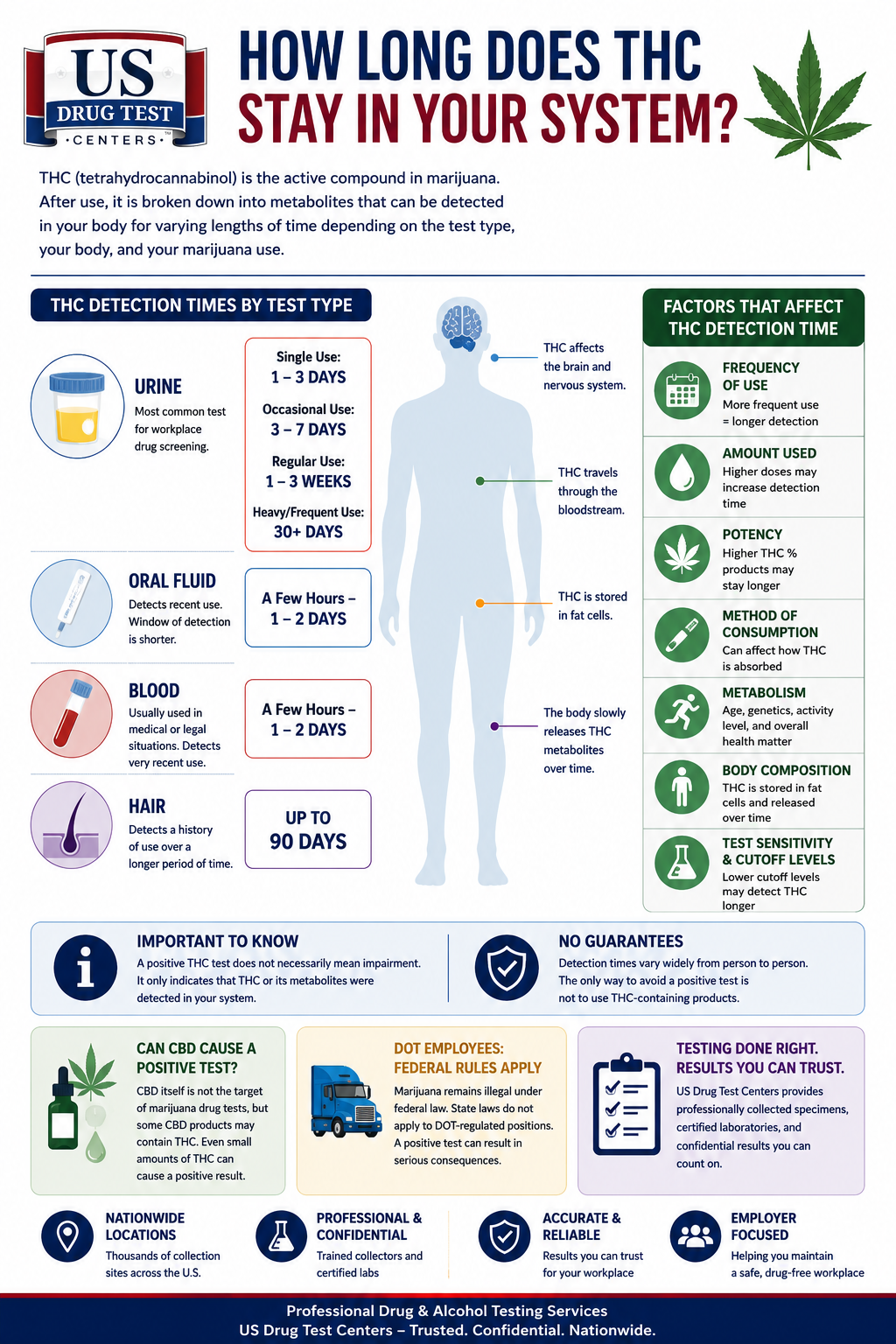
A person’s frequency of use, the potency of the product, metabolism, body composition, hydration, test cutoff levels, and other factors can all affect the result. The type of specimen being tested also matters. A urine drug test, for example, usually has a much longer detection window than an oral fluid or blood test.
It is also important to understand that a positive drug test does not necessarily prove that someone is currently impaired. Drug tests generally identify THC or THC metabolites that remain after the immediate effects have passed.
This guide explains how THC is processed, how long it may be detected in urine and other specimens, and what employers and individuals should know about marijuana drug testing.
What Is THC?
THC stands for tetrahydrocannabinol. It is the primary psychoactive compound associated with marijuana or cannabis. After THC enters the body, it is absorbed into the bloodstream and distributed throughout the body. The liver then breaks it down into other compounds known as metabolites.
One of the primary metabolites tested in urine is 11-nor-9-carboxy-THC, commonly abbreviated as THC-COOH. This metabolite is not responsible for marijuana’s intoxicating effects, but it can remain detectable after active THC levels have declined. Because many drug tests look for metabolites rather than impairment, a person may test positive even when they no longer feel the effects of marijuana.
Can You Accurately Predict When THC Will Leave Your System?
No online chart or calculator can guarantee when a particular person will test negative. General detection-window charts are educational estimates. They cannot account for every variable, including frequency, dosage, potency, individual metabolism, specimen concentration, test cutoff, and laboratory method.
Products or techniques claiming to guarantee a negative drug test should be treated skeptically. Attempts to dilute, substitute, or adulterate a specimen may produce an invalid or rejected result and can have serious workplace consequences. The only dependable way to avoid a marijuana-positive test is not to use THC-containing products.
Why Can THC Remain Detectable for So Long?
The body does not follow a precise timetable when eliminating THC. Several variables can influence how long marijuana remains detectable.
Frequency of Use
Frequency is one of the most important factors. A person who uses marijuana once will generally have a shorter detection window than someone who uses it every day. With repeated exposure, metabolites may remain in the body and continue appearing in urine after use has stopped.
Amount Used
A larger dose may introduce more THC into the body, potentially increasing the amount of time required for THC and its metabolites to fall below the test’s cutoff.
Product Potency
Today’s marijuana products vary considerably in THC concentration. Flowers, concentrates, oils, edibles, vape products, and other formulations may contain very different amounts. A product with a higher THC concentration may result in greater exposure than a lower-potency product.
Method of Consumption
The way marijuana is consumed can influence absorption and how the body processes it. Inhaled marijuana and edible products do not produce identical absorption patterns. However, a drug test generally cannot determine exactly how a substance was consumed.
Metabolism
People process substances at different rates. Age, genetics, overall health, liver function, activity level, and other biological factors may affect metabolism and elimination.
Body composition
Because THC is fat-soluble, body composition may influence its distribution and elimination. However, body composition alone cannot reliably predict when a person will test negative.
Test sensitivity and cutoff levels
Every drug testing program uses established cutoff concentrations. A result is not simply based on whether any trace of a substance exists.
The specimen must meet or exceed the applicable cutoff to be reported as positive. Different testing methods, laboratories, programs, or jurisdictions may use different procedures and thresholds.
How Long Does THC Stay in Urine?
Urine is one of the most frequently used specimens for workplace drug testing. It is widely available, relatively affordable to test, and capable of detecting prior marijuana exposure for longer than oral fluid or blood testing in many situations.
Approximate urine detection periods may include:
- Single or one-time use: Approximately one to three days
- Occasional use: Several days to approximately one week
- Regular use: Approximately one to three weeks
- Frequent or heavy use: Thirty days or longer in some cases
These ranges are estimates, not guarantees. Two people who use the same product at the same time may receive different test results. Even the same person could have different detection periods under different circumstances.
How Long Does THC Stay in Hair?
Hair testing generally provides a much longer lookback period than urine, oral fluid, or blood testing. A standard head-hair specimen is often used to evaluate an approximate 90-day period. Drugs incorporated into growing hair may remain present until that portion of hair is cut.
Hair testing does have limitations though. It is not generally considered the best method for identifying very recent exposure because it takes time for newly formed hair containing drug markers to grow above the scalp. Research also indicates that infrequent cannabis exposure can be more difficult to identify through hair testing than repeated exposure.
How Long Does THC Stay in Oral Fluid?
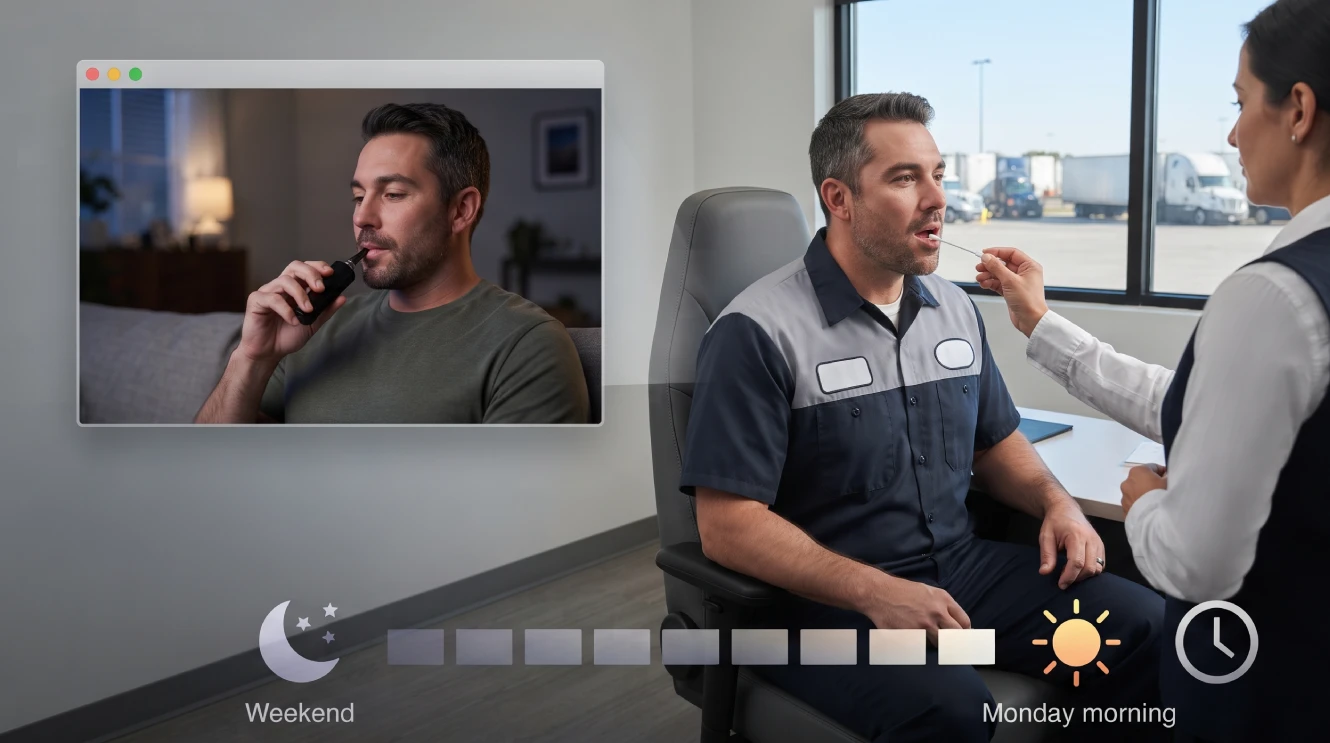
Oral fluid testing, sometimes called saliva or mouth-swab testing, generally has a shorter detection period than urine or hair testing. Depending on the product, collection device, laboratory cutoff, method of consumption, and frequency of use, THC may be detectable in oral fluid from a few hours to approximately one or two days.
Controlled studies have reported THC detection periods extending up to approximately 22 hours in some oral-fluid specimens, although actual results vary significantly according to the study and cutoff used. Collection can also be directly observed, which helps reduce certain opportunities for specimen substitution or tampering.
How Long Does THC Stay in Blood?
Blood testing usually focuses on a shorter period than urine testing and may be used in medical, forensic, or post-incident situations. Active THC levels typically decline more rapidly in blood than urine metabolites do in urine. However, low concentrations may remain detectable longer in frequent users, and detection varies according to the sensitivity of the analytical method.
A blood result can be more closely associated with recent exposure than a urine result, but it still should not automatically be interpreted as a precise measurement of impairment.
Does a Positive THC Test Prove Impairment?
No. A positive drug test generally demonstrates that the applicable drug or metabolite was detected at or above the program’s cutoff.
It does not necessarily establish:
- The exact time marijuana was used
- The exact quantity consumed
- The specific product used
- Whether the individual was impaired when the specimen was collected
- Whether the person was impaired while working
The National Institute on Drug Abuse emphasizes that drug testing results must be interpreted according to what the particular specimen and test can actually establish. Testing may demonstrate exposure, but it does not always answer questions about timing, dosage, or impairment. This distinction is especially important when employers develop workplace policies or evaluate non-DOT test results.
Can CBD Cause a Positive Marijuana Drug Test?
CBD itself is not generally the target of a standard marijuana drug test. However, some products advertised as full-spectrum CBD may contain measurable THC. Other products could also contain more THC than their labels indicate because of contamination, inconsistent manufacturing, or inaccurate labeling.
The U.S. Department of Transportation warns safety-sensitive employees that CBD product labels may be misleading and that using a CBD product is not considered a valid explanation for a confirmed positive marijuana result under DOT regulations. Individuals subject to workplace testing should understand that products advertised as legal, hemp-derived, or THC-free may still create testing risks.
What Is the Difference Between a Screening and Confirmation Test?
Professional drug testing programs commonly use a two-step process.
The first test is an initial screening test. If the result is negative, it is generally reported as negative without additional testing. If the initial test is at or above the screening cutoff, the specimen may undergo a second, more specific confirmation test. Confirmation testing uses advanced laboratory methods to identify and measure the applicable drug or metabolite.
In federally regulated programs, a Medical Review Officer, or MRO, reviews confirmed laboratory results according to established procedures before a final verified result is reported. This process helps distinguish a properly confirmed positive from an unverified rapid-screening result.
Are DOT Marijuana Rules Different?
Yes. DOT-regulated testing is governed by federal requirements, including 49 CFR Part 40 and the rules of the applicable DOT agency.
State legalization of recreational or medical marijuana does not change DOT requirements for safety-sensitive transportation employees. The DOT states that marijuana remains unacceptable for employees performing DOT-regulated safety-sensitive functions.
A state medical-marijuana authorization is also not accepted as a legitimate medical explanation for a positive DOT marijuana test. Employers regulated by the FMCSA, FAA, FRA, FTA, PHMSA, or USCG must follow the rules of the applicable agency rather than relying solely on state marijuana laws.
What Should Employers Know About Marijuana Testing?
Employers should have a clear, written drug and alcohol testing policy that reflects:
- Federal regulations, when applicable
- State and local marijuana laws
- The positions covered by testing
- The circumstances that trigger testing
- The specimen types used
- Laboratory and MRO procedures
- Consequences of policy violations
- Employee and applicant notification requirements
State laws vary significantly. Some states limit when employers may conduct marijuana testing or what actions may be taken based on lawful off-duty activity. Other states provide broader employer protections, particularly for safety-sensitive positions.
Employers should review their programs regularly and seek qualified legal guidance when necessary.
Schedule Marijuana Drug Testing with US Drug Test Centers
With access to over 20,000 testing locations across the United States, US Drug Test Centers helps employers and individuals arrange reliable testing with professional collections and certified laboratory services.
Available testing options may include:
- Urine drug testing
- Hair drug testing
- Oral fluid drug testing
- DOT-regulated testing
- Non-DOT workplace testing
- Pre-employment testing
- Random testing
- Post-accident testing
- Reasonable-suspicion testing
- Return-to-duty and follow-up testing
- Employer drug-free workplace programs.
Employers should use properly designed testing programs, certified laboratories, qualified collectors, and Medical Review Officer services when appropriate. For professional marijuana drug testing or assistance establishing a compliant workplace testing program, contact US Drug Test Centers today.