





US Drug Test Centers Blog
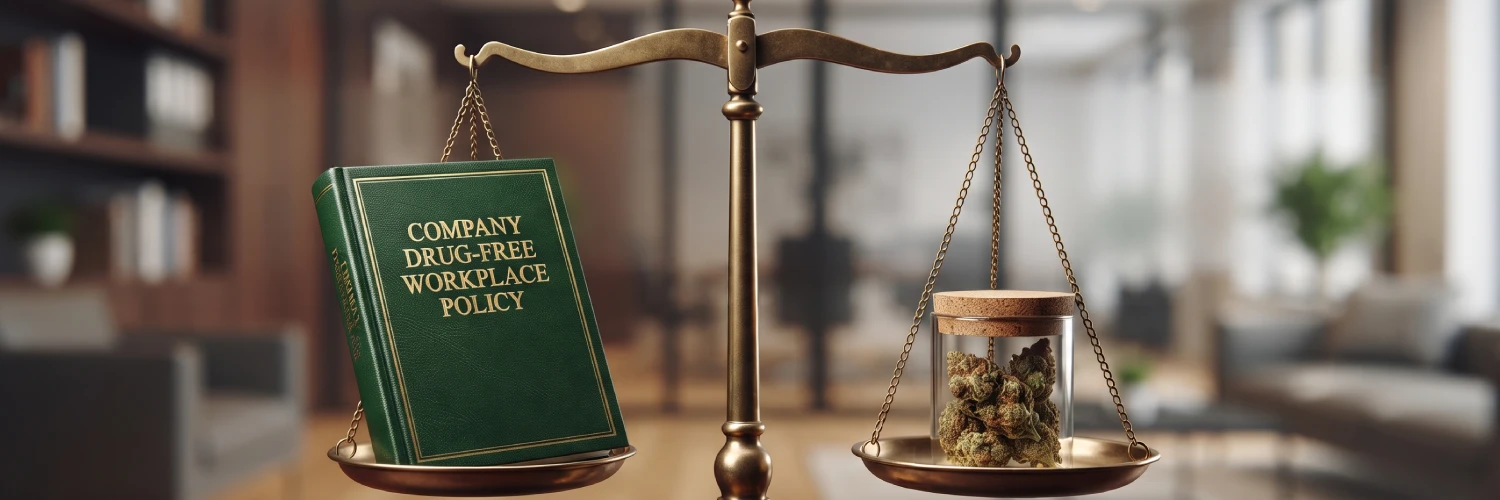
Can an Employer Still Have a Drug-Free Workplace in a Marijuana-Legal State?
Yes. Not one state that has legalized marijuana has taken away an employer's ability to prohibit use, possession, or impairment on the job.
What has changed is narrower and more specific than most employers believe: in a growing number of states, an employer's ability to act on a positive THC test alone is now limited. That is a real change. It is not the same thing as losing the right to a drug-free workplace, and the gap between those two ideas is where most of the confusion lives.
Here are the misconceptions that come up most often, and what the reality actually is.
Myth 1: "Marijuana is legal here, so I can't prohibit it at work."
Reality: State legalization laws govern what individuals may do. They do not require employers to permit it on the job. Every recreational legalization statute preserves an employer's authority to prohibit use, possession, and impairment during work. An employee who shows up impaired, uses on a break, or keeps product in a company vehicle is violating a policy you are entitled to enforce in all fifty states.
Myth 2: "Zero tolerance policies are illegal now."
Reality: This depends entirely on what you mean by zero tolerance.
Zero tolerance for on-duty use, possession, or impairment remains lawful everywhere. No state has touched that.
Zero tolerance in the sense of "any positive THC test results in termination, regardless of when the person used" is what a growing number of states now restrict, and only for certain employees. California and Connecticut are among the states that limit adverse action based solely on off-duty cannabis use or a positive THC result, while continuing to allow discipline for actual on-the-job impairment. Safety-sensitive positions and federally regulated roles are generally carved out.
So the policy is not illegal. The blanket, one-size-fits-all version of it has become risky in specific states for specific roles.
Myth 3: "A positive test proves the employee was impaired at work."
Reality: It does not, and this is the technical fact underlying nearly every legal change in this area.
A standard urine test detects an inactive THC metabolite. It confirms consumption at some point. In regular users, metabolites can remain detectable for days or weeks after any impairing effect has ended. No test currently available reliably measures real-time marijuana impairment.
This matters practically because several state statutes now require an employer to demonstrate impairment, not just a positive result, before taking adverse action against a non-exempt employee. If your policy treats a lab report as proof of impairment, it is making a claim the science does not support.
Myth 4: "We're a DOT employer, so federal law covers our whole company."
Reality: Federal rules cover federally regulated employees, not federally regulated companies.
If you operate commercial motor vehicles, your safety-sensitive drivers are subject to DOT testing requirements, marijuana is prohibited for them on duty and off, and state legalization is irrelevant to that population. None of that extends automatically to your dispatchers, mechanics who do not perform safety-sensitive functions, office staff, or sales team.
Applying DOT rules to non-DOT employees is one of the most common structural errors in this area. It creates exposure under state law for the non-covered group, and it can muddy your DOT program by mixing populations that must be documented separately. Most employers in this position should be running two clearly delineated programs.
Myth 5: "Our headquarters state's law applies to everyone."
Reality: Employment law generally follows where the employee works, not where the company is incorporated or headquartered.
An employer based in a permissive state with remote or field employees in protective states is subject to the protective states' rules for those employees. As distributed workforces have become normal, this has quietly turned single-state policies into multi-state compliance problems for companies that never thought of themselves as multi-state employers.
Myth 6: "If I have to accommodate medical marijuana, I have to allow use at work."
Reality: Accommodation obligations vary considerably by state. Some states require reasonable accommodation for registered medical patients, others expressly do not. However, even where accommodation is required, it essentially never means permitting on-duty use or tolerating impairment.
In practice, accommodation in this context typically concerns off-duty use by a registered patient, and whether a positive test alone can support an adverse action. Federal disability law does not require accommodating marijuana use, since it remains federally controlled; state disability law may reach a different result. This is the most jurisdiction-specific issue in the entire subject and the one most worth running past counsel before you face it.
Myth 7: "The 2026 rescheduling changed our obligations."
Reality: It has not changed anything for employers yet.
The April 2026 federal order moved two narrow categories into Schedule III: FDA-approved marijuana drug products and marijuana dispensed under a state medical license. Recreational marijuana remained in Schedule I, and a broader proceeding on general rescheduling is ongoing.
Federal drug testing panels were confirmed unchanged, marijuana remains on them, and DOT has been explicit that a change in a drug's schedule does not by itself amend its testing regulations. Rescheduling also does not override state employment law. The most useful thing an employer can do right now is send a clear internal message, because employees are reading headlines and drawing their own conclusions.
Myth 8: "A drug-free workplace means a drug testing program."
Reality: The Drug-Free Workplace Act of 1988, which applies to federal contractors above a threshold and to federal grant recipients, does not require drug testing at all. It requires a published policy statement, an employee awareness program, and specific notification procedures following certain drug convictions.
Testing is a separate decision, driven by other regulations, contracts, insurance requirements, or your own risk judgment. Employers regularly conflate the two and end up believing they have obligations they do not have, or missing the policy obligations they actually do.
What Employers Can Still Do
Strip away the complexity and a substantial core of authority is intact in every state:
- Prohibit the use, possession, and distribution of marijuana on company property, in company vehicles, and during working hours
- Prohibit working while impaired, and discipline employees who do
- Test where federal law requires it, with no state law exception
- Test safety-sensitive employees, subject to how your state defines that category
- Conduct reasonable suspicion testing supported by documented behavioral observation
- Conduct post-accident testing under a defined, consistently applied policy
- Maintain a written drug-free workplace policy and require acknowledgment of it
- Train supervisors to recognize and document impairment
What has narrowed is a specific thing: acting against a non-safety-sensitive employee in a protective state on the basis of a positive THC test with nothing else behind it. Policies built on documented observation of impairment have held up considerably better than policies built on lab results alone.
The Practical Takeaway
A drug-free workplace is not an obsolete concept. It is a concept that now requires role-based structure and state-specific language rather than a single paragraph applied uniformly to everyone.
If your policy still says "any positive drug test will result in termination" and you employ people in more than one state, that sentence is doing more harm than good.
US Drug Test Centers works with employers nationwide on DOT and non-DOT testing programs, drug-free workplace policies and manuals, supervisor and DER training, and multi-state policy review. If you are not confident your current policy holds up in every state where you employ people, we can help you find out.
This article is provided for general informational purposes and is not legal advice. Cannabis and employment law varies substantially by state and continues to change at the federal, state, and local levels. Consult qualified employment counsel before adopting or revising a workplace policy.