





US Drug Test Centers Blog
What Happens If I Refuse a Drug Test?
If you're asked to take a drug test, whether for a new job, after a workplace accident, or as part of a random testing program, you may wonder if you can simply refuse. The short answer is yes, you can refuse to take a drug test. However, refusing a drug test often carries significant consequences, especially if testing is required by your employer or federal regulations.
Depending on your job, company policy, and whether you're subject to Department of Transportation (DOT) regulations, refusing a drug test could result in a withdrawn job offer, disciplinary action, termination of employment, or being immediately removed from safety-sensitive duties.
In this guide, we'll explain what happens when someone refuses a drug test, how refusal rules differ for DOT and non-DOT employees, and what employers should know when creating workplace drug testing policies.
Common Reasons Employers Require Drug Testing
Employers may request drug testing for several reasons, including:
- Pre-employment screening
- Random drug testing
- Reasonable suspicion
- Post-accident testing
- Return-to-duty testing
- Follow-up testing
- Periodic or annual testing (where permitted)
Each testing situation may have different rules regarding refusals.
Can You Refuse a Drug Test?
In most cases, yes. No one can physically force you to provide a urine, hair, oral fluid, or other specimen. However, refusing a required drug test does not mean there are no consequences. Employers generally have the right to enforce their drug and alcohol testing policies as a condition of employment, provided those policies comply with applicable federal, state, and local laws.
The consequences of refusing a test often depend on:
- If the employer is regulated by the DOT
- The employer's written drug-free workplace policy
- State employment laws
- Union agreements or employment contracts
- The reason the test was requested
Understanding your employer's policy, your industry's regulations, and your rights under applicable law can help you make informed decisions if you're ever asked to submit to a drug or alcohol test.
What Happens If You Refuse a Pre-Employment Drug Test?
For most private employers, refusing a pre-employment drug test usually results in one outcome: The employer simply chooses not to hire the applicant. Many companies make passing a drug test a condition of employment.
If an applicant refuses, the employer may:
- Withdraw the job offer
- Remove the applicant from consideration
- Require the applicant to reapply later (depending on company policy)
Unlike current employees, applicants generally have fewer workplace protections because employment has not yet begun.
What Happens If a Current Employee Refuses?
The consequences may be more serious.
Depending on company policy, refusing a required drug test could result in:
- Written disciplinary action
- Suspension
- Loss of safety-sensitive responsibilities
- Termination of employment
- Ineligibility for future promotion
- Other disciplinary measures allowed by company policy
Every employer's policy is different, so employees should carefully review their company's drug and alcohol testing policy.
DOT Drug Testing Refusals Are Different
Employees regulated by the Department of Transportation (DOT) face much stricter rules.
DOT regulations apply to safety-sensitive employees covered by agencies such as:
- Federal Motor Carrier Safety Administration (FMCSA)
- Federal Aviation Administration (FAA)
- Federal Railroad Administration (FRA)
- Federal Transit Administration (FTA)
- Pipeline and Hazardous Materials Safety Administration (PHMSA)
- United States Coast Guard (USCG)
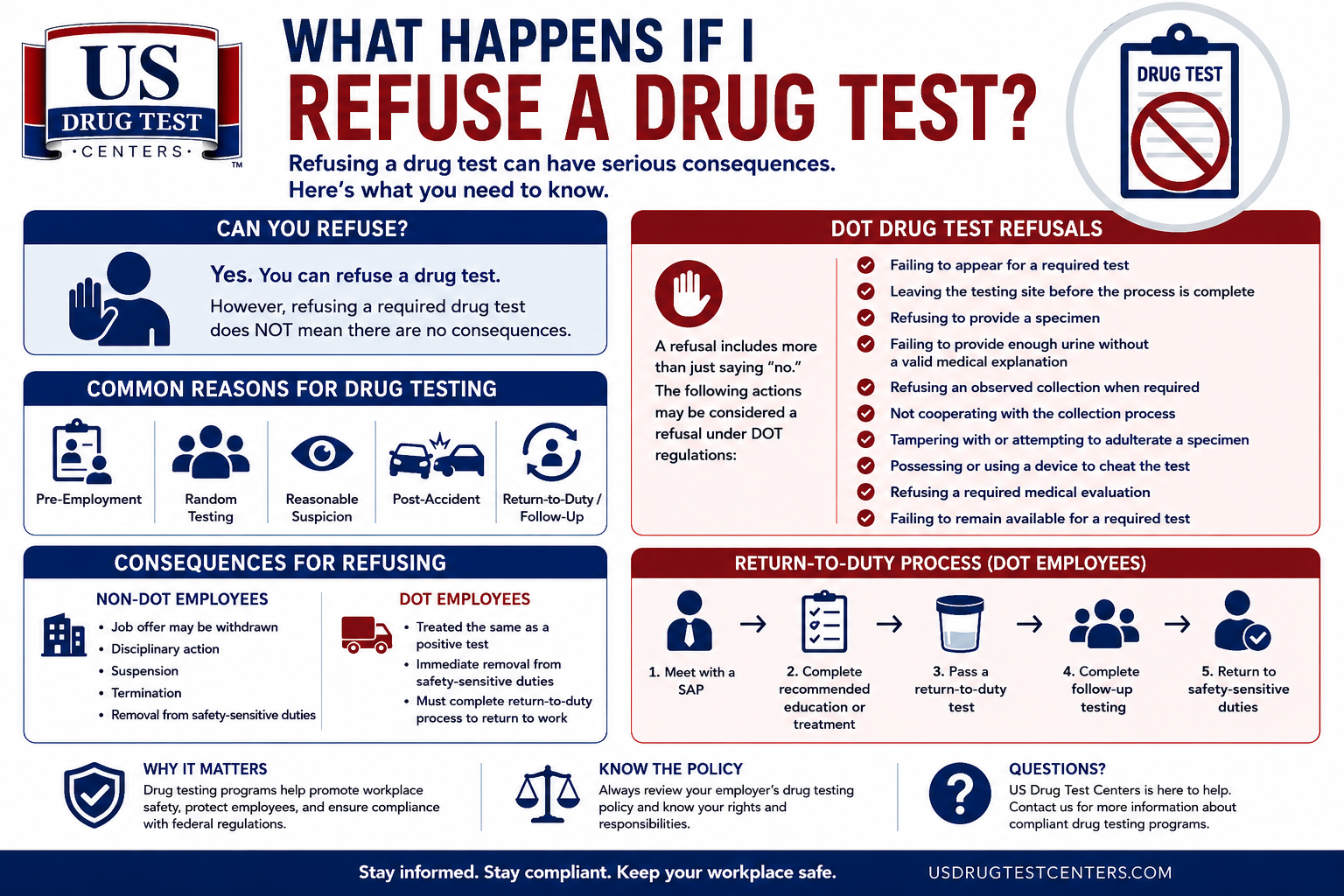
For these employees, refusing a required DOT drug or alcohol test is generally treated the same as a positive test.
What Counts as a DOT Refusal?
Many people believe refusing simply means saying: "I won't take the test." In reality, DOT regulations define several actions as refusals.
Examples include:
- Failing to appear for a required test
- Leaving the testing site before the process is complete
- Refusing to provide a specimen
- Failing to provide enough urine without a valid medical explanation
- Refusing an observed collection when required
- Not cooperating with the collection process
- Tampering with or attempting to adulterate a specimen
- Refusing to undergo a required medical evaluation after an insufficient specimen
- Failing to remain available for a required post-accident test when applicable
In other words, a refusal can occur even if a person never explicitly says, "I refuse."
What Happens After a DOT Refusal?
If a DOT-covered employee refuses a required test: They must be immediately removed from safety-sensitive duties.
Before returning to DOT-covered work, they generally must:
- Be evaluated by a qualified Substance Abuse Professional (SAP)
- Complete any education or treatment recommended by the SAP
- Successfully complete the return-to-duty process
- Pass a return-to-duty drug or alcohol test
- Complete required follow-up testing
These requirements are established under federal DOT regulations.
Can I Refuse Because I Have a Prescription?
Employees should not refuse testing because they take prescribed medication. Before submitting to a drug test, they should make note of any current prescriptions, if able. If a laboratory-confirmed result requires review, a Medical Review Officer (MRO) may evaluate legitimate prescriptions as part of the verification process, depending on the testing program.
Can Medical Marijuana Be Used as a Reason to Refuse?
No. A medical marijuana card does not excuse an employee from refusing a required drug test. For DOT-regulated employees, marijuana remains prohibited regardless of state legalization.
For private employers, state laws vary considerably. Some states provide employment protections for medical marijuana users, while others allow employers to maintain drug-free workplace policies that prohibit marijuana use. Employees should understand both company policy and applicable state law.
What If You're Unable to Provide a Urine Sample?
Sometimes an employee is willing to test but cannot immediately provide enough urine. This is not automatically considered a refusal. DOT regulations include a "shy bladder" procedure that allows additional time to produce a sufficient specimen.
If the employee still cannot provide enough urine, the Medical Review Officer (MRO) may require a medical evaluation to determine whether a legitimate medical condition exists. If no valid medical explanation is identified, the situation may ultimately be reported as a refusal under DOT regulations. Many non-DOT employers have similar procedures, although their policies may differ.
Does Refusing Look Worse Than Failing?
Many employees ask if refusing is "better" than testing positive. From an employment perspective, the answer is often no.
For DOT-regulated employees, a refusal is generally treated as a drug and alcohol testing violation with consequences similar to a verified positive result.
For private employers, many policies treat refusal as a serious policy violation that may result in the same disciplinary action as a positive test.
Why Do Employers Treat Refusals Seriously?
Drug testing programs only work when employees participate as required. If employees could simply refuse testing without consequences, workplace drug testing programs would be much less effective.
Employers use testing programs to help:
- Promote workplace safety
- Reduce accidents
- Protect employees
- Meet insurance requirements
- Comply with federal regulations
- Support drug-free workplace policies
Refusing a drug test is a decision that can have serious employment consequences. While individuals generally cannot be physically forced to provide a specimen, employers often have the right to enforce workplace drug testing policies, and DOT-regulated employees are subject to strict federal refusal rules.
What Should Employers Include in Their Drug Testing Policy?
A written drug and alcohol policy should clearly explain:
- When testing is required
- Which employees are covered
- Types of testing performed
- Consequences of refusing a test
- Consequences of positive results
- Return-to-duty procedures (if applicable)
- Employee rights and responsibilities
- Compliance with applicable laws
A clear policy helps reduce misunderstandings and supports consistent decision-making.
How US Drug Test Centers Helps Employers
US Drug Test Centers partners with employers nationwide to simplify workplace drug testing and compliance.
Our services include:
- Pre-employment drug testing
- Random drug testing programs
- DOT and non-DOT drug testing
- Hair drug testing
- Oral fluid drug testing
- Alcohol testing
- Consortium and Third-Party Administrator (C/TPA) services
- DOT compliance support
- Occupational health services
- Nationwide testing locations
If your organization needs help creating a compliant workplace drug testing program, administering DOT or non-DOT testing, or managing random testing requirements, US Drug Test Centers provides nationwide testing services and compliance support to help employers maintain safe, drug-free workplaces.
Source: what-happens-if-i-refuse-a-drug-test